Valid Non-compete Agreement Form for Illinois
In the competitive landscape of Illinois employment, the Non-compete Agreement serves as a crucial tool for employers seeking to protect their business interests. This form outlines specific conditions under which employees agree not to engage in similar work or start competing businesses within a designated geographical area for a specified period after leaving their current job. Key components of the agreement typically include the duration of the restriction, the geographical scope, and the nature of the restricted activities. It is essential for both employers and employees to understand the implications of this agreement, as it can significantly impact future employment opportunities and business operations. Moreover, the enforceability of such agreements can vary based on several factors, including reasonableness and the specific circumstances surrounding the employment relationship. As Illinois law continues to evolve, staying informed about the latest developments regarding Non-compete Agreements is vital for both parties involved.
Common mistakes
-
Not understanding the purpose of the agreement: Many individuals fill out the form without fully grasping its implications. A non-compete agreement restricts your ability to work in similar industries after leaving a job. Understanding this is crucial before signing.
-
Failing to specify the duration: The agreement should clearly state how long the restrictions will last. Leaving this blank or vague can lead to confusion and potential legal issues later on.
-
Ignoring geographical limitations: It's important to define the geographic area where the non-compete applies. A poorly defined area can lead to disputes about where you can work.
-
Not considering the scope of work: The agreement should outline the specific roles or types of employment that are restricted. Failing to detail this can result in overly broad restrictions that may not be enforceable.
-
Overlooking compensation details: If the agreement includes any compensation for the non-compete period, it should be clearly stated. Many forget to address this, which can lead to misunderstandings.
-
Neglecting to review with legal counsel: Some individuals skip this step, thinking they can handle it on their own. Consulting with a lawyer can help clarify any confusing terms and ensure your rights are protected.
-
Not keeping a copy of the signed agreement: After signing, it's essential to retain a copy for your records. Without it, you may struggle to remember the terms or defend yourself if disputes arise.
-
Rushing through the process: Filling out the form quickly can lead to mistakes. Take your time to read each section carefully and ensure all information is accurate.
-
Assuming the agreement is standard: Every non-compete agreement is unique. Just because someone else signed a similar one doesn’t mean yours will have the same terms or enforceability. Always review your specific agreement carefully.
Example - Illinois Non-compete Agreement Form
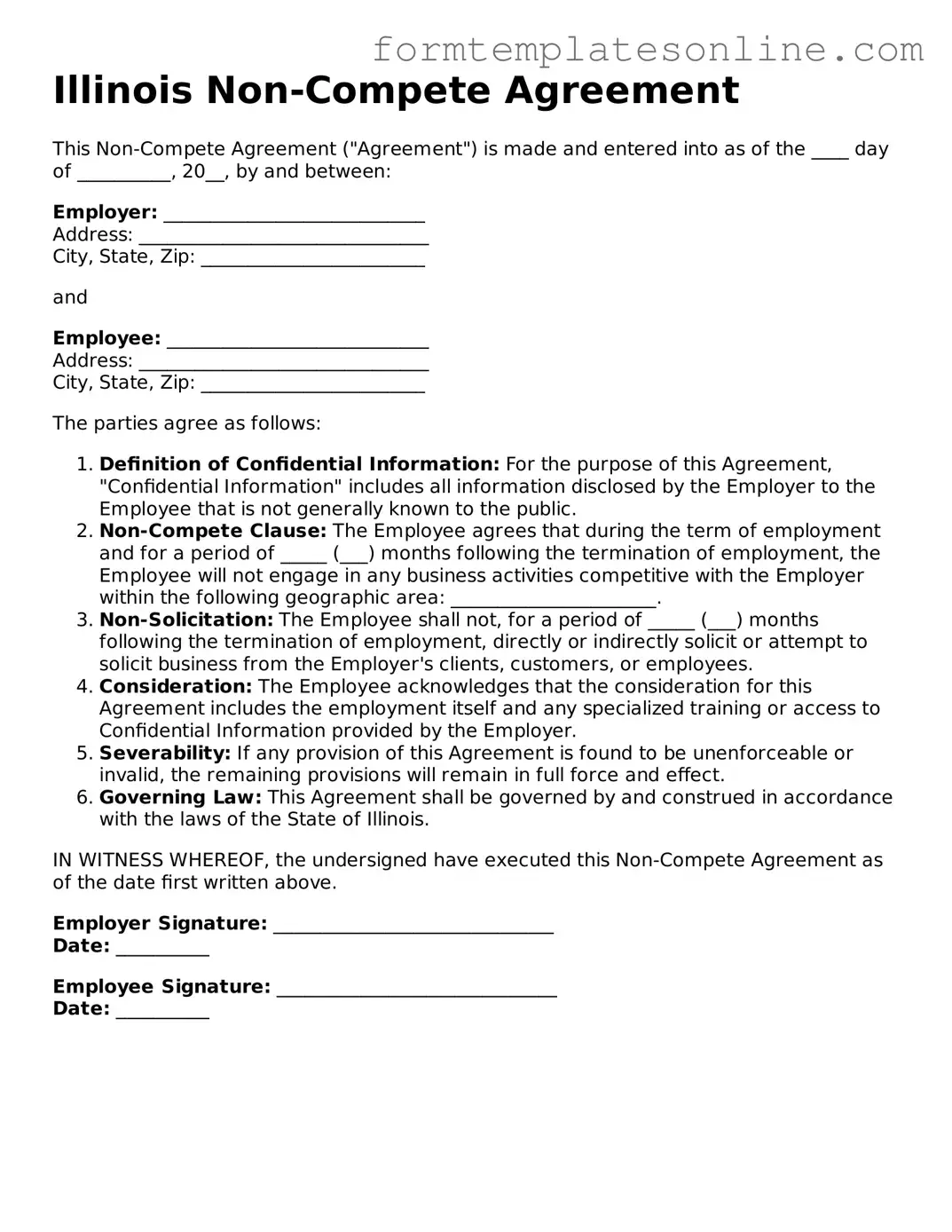
Illinois Non-Compete Agreement
This Non-Compete Agreement ("Agreement") is made and entered into as of the ____ day of __________, 20__, by and between:
Employer: ____________________________
Address: _______________________________
City, State, Zip: ________________________
and
Employee: ____________________________
Address: _______________________________
City, State, Zip: ________________________
The parties agree as follows:
- Definition of Confidential Information: For the purpose of this Agreement, "Confidential Information" includes all information disclosed by the Employer to the Employee that is not generally known to the public.
- Non-Compete Clause: The Employee agrees that during the term of employment and for a period of _____ (___) months following the termination of employment, the Employee will not engage in any business activities competitive with the Employer within the following geographic area: ______________________.
- Non-Solicitation: The Employee shall not, for a period of _____ (___) months following the termination of employment, directly or indirectly solicit or attempt to solicit business from the Employer's clients, customers, or employees.
- Consideration: The Employee acknowledges that the consideration for this Agreement includes the employment itself and any specialized training or access to Confidential Information provided by the Employer.
- Severability: If any provision of this Agreement is found to be unenforceable or invalid, the remaining provisions will remain in full force and effect.
- Governing Law: This Agreement shall be governed by and construed in accordance with the laws of the State of Illinois.
IN WITNESS WHEREOF, the undersigned have executed this Non-Compete Agreement as of the date first written above.
Employer Signature: ______________________________
Date: __________
Employee Signature: ______________________________
Date: __________
More About Illinois Non-compete Agreement
What is a non-compete agreement in Illinois?
A non-compete agreement is a contract between an employer and an employee that restricts the employee from engaging in activities that compete with the employer's business after the employment relationship ends. In Illinois, these agreements are enforceable under certain conditions, primarily focusing on the reasonableness of the terms.
What are the key elements of a valid non-compete agreement in Illinois?
To be considered valid, a non-compete agreement in Illinois must meet three main criteria: it must be reasonable in duration, geographic scope, and the activities it restricts. Additionally, the agreement must protect a legitimate business interest of the employer, such as trade secrets or customer relationships.
How long can a non-compete agreement last in Illinois?
The duration of a non-compete agreement in Illinois should be reasonable, typically ranging from six months to two years, depending on the nature of the business and the role of the employee. Courts will assess the specific circumstances surrounding each case to determine if the duration is appropriate.
Are there specific industries where non-compete agreements are more common?
Non-compete agreements are frequently used in industries such as technology, healthcare, finance, and sales. These sectors often have sensitive information or client relationships that employers seek to protect through such agreements.
Can an employee negotiate the terms of a non-compete agreement?
Yes, employees can negotiate the terms of a non-compete agreement before signing. It is advisable for employees to seek modifications that make the agreement more favorable, such as shortening the duration or limiting the geographic scope.
What happens if a non-compete agreement is violated?
If an employee violates a non-compete agreement, the employer may seek legal action to enforce the agreement. This could involve seeking an injunction to prevent the employee from competing or pursuing damages for any losses incurred due to the violation.
Is it possible to contest a non-compete agreement in Illinois?
Yes, it is possible to contest a non-compete agreement in Illinois. An employee may argue that the agreement is overly broad, unreasonable, or lacks consideration. Courts will evaluate the agreement based on established legal standards to determine its enforceability.
Key takeaways
When filling out and using the Illinois Non-compete Agreement form, consider the following key takeaways:
- Understand the Purpose: A non-compete agreement restricts an employee's ability to work in similar industries after leaving a job, protecting the employer's business interests.
- Ensure Reasonableness: The agreement must be reasonable in scope, duration, and geographic area to be enforceable under Illinois law.
- Consider Employee's Position: Higher-level employees with access to sensitive information may face stricter non-compete terms compared to lower-level employees.
- Provide Consideration: For the agreement to be valid, the employee must receive something of value in exchange, such as a job offer or a promotion.
- Be Clear and Specific: Clearly outline the restrictions and terms to avoid ambiguity. This helps both parties understand their rights and obligations.
- Consult Legal Expertise: It is advisable to seek legal guidance when drafting or signing a non-compete agreement to ensure compliance with current laws and regulations.
File Details
| Fact Name | Description |
|---|---|
| Governing Law | The Illinois Non-compete Agreement is governed by the Illinois Freedom to Work Act. |
| Enforceability | Non-compete agreements in Illinois are enforceable only if they are reasonable in scope and duration. |
| Employee Protections | Illinois law prohibits non-compete agreements for low-wage employees earning less than $75,000 annually. |
| Consideration Requirement | For a non-compete agreement to be valid, there must be adequate consideration, such as employment or promotion. |
Consider Some Other Non-compete Agreement Forms for US States
Typical Non Compete Agreement - Violating a Non-compete Agreement can result in legal action, including lawsuits for damages.
Pennsylvania Non Compete Law - This agreement is an essential part of the employer's overall strategy for business continuity.
The Affidavit of Residency form is crucial for individuals needing to verify their residency status in Florida, leading to easier navigation through processes such as securing a driver's license. For more detailed guidelines, refer to the comprehensive Affidavit of Residency form resources available at comprehensive Affidavit of Residency form.
New York Non Compete Law 2023 - Provides a framework for resolving disputes related to competitive practices.
Are Non-competes Enforceable in California - It serves as a legal framework for protecting a company’s competitive advantage.
Dos and Don'ts
When filling out the Illinois Non-compete Agreement form, it's important to be careful and thorough. Here are some things to keep in mind:
- Do read the entire agreement carefully before signing.
- Do ensure that the terms are reasonable and fair for both parties.
- Don't rush through the process; take your time to understand each section.
- Don't ignore any clauses that seem unclear or overly restrictive.