96 Well PDF Form
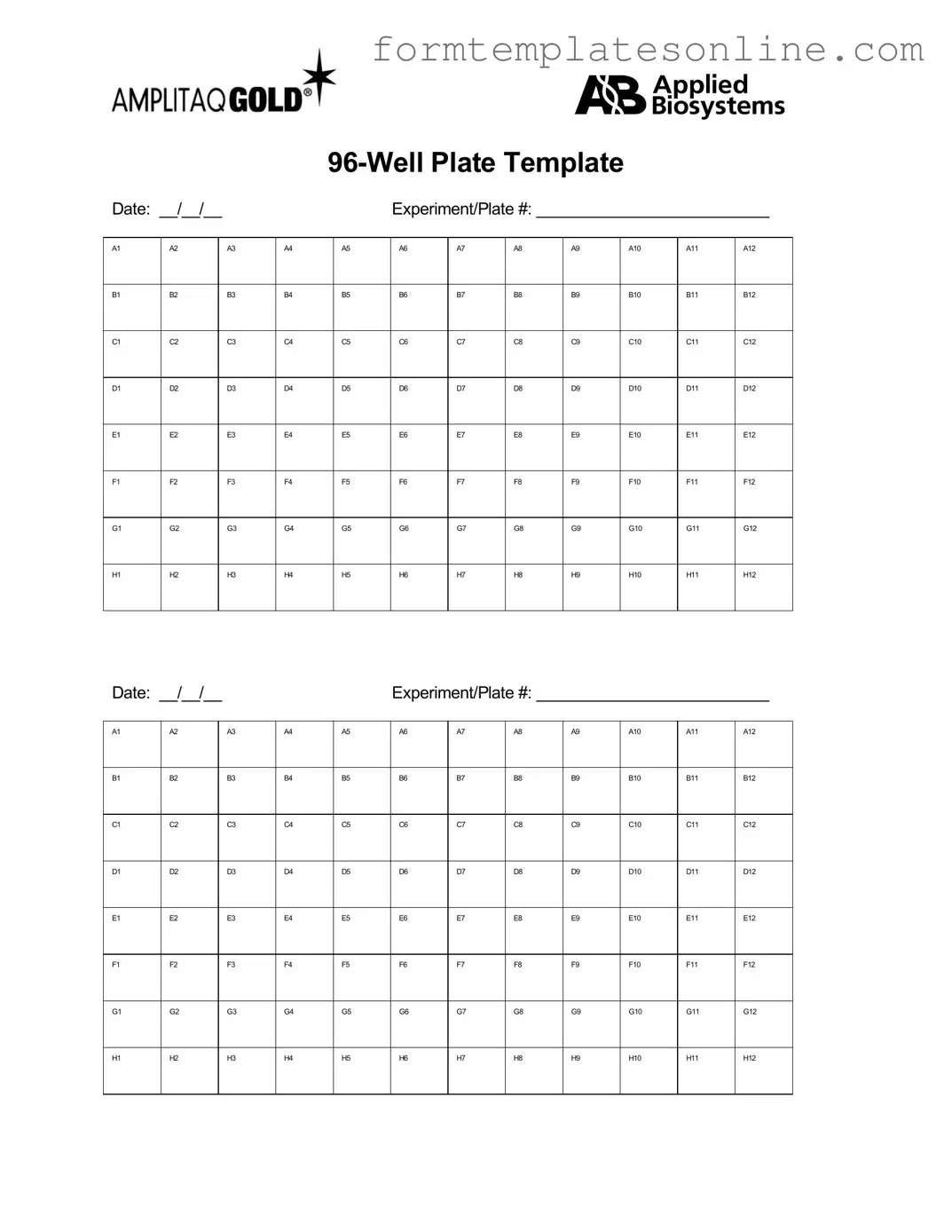
The 96 Well form serves as a critical tool in various scientific and research fields, facilitating the organization and analysis of data collected from experiments. This form is designed to accommodate a range of applications, including biochemical assays, genetic testing, and other laboratory procedures that require systematic data collection. Each of the 96 wells provides a designated space for samples, allowing researchers to conduct multiple tests simultaneously while maintaining clarity and precision. The layout of the form is typically structured in an 8x12 grid, which aids in easy identification and tracking of samples. In addition to its physical design, the 96 Well form often includes sections for recording essential details such as sample identifiers, reagent information, and experimental conditions. By streamlining the documentation process, this form enhances data integrity and supports reproducibility in scientific research. Whether utilized in academic laboratories or industrial settings, the 96 Well form plays an indispensable role in ensuring that experiments are conducted efficiently and results are accurately captured.
Common mistakes
-
Incomplete Information: Many individuals fail to fill out all required fields. Leaving sections blank can lead to delays in processing.
-
Incorrect Data Entry: Typographical errors are common. Double-checking for accuracy is essential to avoid complications.
-
Using Incorrect Formats: Each field may require specific formats, such as dates or numerical values. Not adhering to these formats can result in rejection of the form.
-
Neglecting Signatures: Failing to sign the form can render it invalid. Always ensure that all necessary signatures are included before submission.
-
Missing Supporting Documents: Some submissions require additional documentation. Not including these documents can delay processing or result in denial.
-
Ignoring Deadlines: Each form has a specific submission deadline. Missing this deadline can lead to missed opportunities or penalties.
Example - 96 Well Form

Date: __/__/__ |
|
|
|
Experiment/Plate #: __________________________ |
||||||||
|
|
|
|
|
|
|
|
|
|
|
|
|
A1 |
A2 |
|
A3 |
A4 |
A5 |
A6 |
A7 |
A8 |
A9 |
A10 |
A11 |
A12 |
|
|
|
|
|
|
|
|
|
|
|
|
|
B1 |
B2 |
|
B3 |
B4 |
B5 |
B6 |
B7 |
B8 |
B9 |
B10 |
B11 |
B12 |
|
|
|
|
|
|
|
|
|
|
|
|
|
C1 |
C2 |
|
C3 |
C4 |
C5 |
C6 |
C7 |
C8 |
C9 |
C10 |
C11 |
C12 |
|
|
|
|
|
|
|
|
|
|
|
|
|
D1 |
D2 |
|
D3 |
D4 |
D5 |
D6 |
D7 |
D8 |
D9 |
D10 |
D11 |
D12 |
|
|
|
|
|
|
|
|
|
|
|
|
|
E1 |
E2 |
|
E3 |
E4 |
E5 |
E6 |
E7 |
E8 |
E9 |
E10 |
E11 |
E12 |
|
|
|
|
|
|
|
|
|
|
|
|
|
F1 |
F2 |
|
F3 |
F4 |
F5 |
F6 |
F7 |
F8 |
F9 |
F10 |
F11 |
F12 |
|
|
|
|
|
|
|
|
|
|
|
|
|
G1 |
G2 |
|
G3 |
G4 |
G5 |
G6 |
G7 |
G8 |
G9 |
G10 |
G11 |
G12 |
|
|
|
|
|
|
|
|
|
|
|
|
|
H1 |
H2 |
|
H3 |
H4 |
H5 |
H6 |
H7 |
H8 |
H9 |
H10 |
H11 |
H12 |
|
|
|
|
|
|
|
|
|
|
|
|
|
Date: __/__/__ |
|
|
|
Experiment/Plate #: __________________________ |
||||||||
|
|
|
|
|
|
|
|
|
|
|
|
|
A1 |
A2 |
|
A3 |
A4 |
A5 |
A6 |
A7 |
A8 |
A9 |
A10 |
A11 |
A12 |
|
|
|
|
|
|
|
|
|
|
|
|
|
B1 |
B2 |
|
B3 |
B4 |
B5 |
B6 |
B7 |
B8 |
B9 |
B10 |
B11 |
B12 |
|
|
|
|
|
|
|
|
|
|
|
|
|
C1 |
C2 |
|
C3 |
C4 |
C5 |
C6 |
C7 |
C8 |
C9 |
C10 |
C11 |
C12 |
|
|
|
|
|
|
|
|
|
|
|
|
|
D1 |
D2 |
|
D3 |
D4 |
D5 |
D6 |
D7 |
D8 |
D9 |
D10 |
D11 |
D12 |
|
|
|
|
|
|
|
|
|
|
|
|
|
E1 |
E2 |
|
E3 |
E4 |
E5 |
E6 |
E7 |
E8 |
E9 |
E10 |
E11 |
E12 |
|
|
|
|
|
|
|
|
|
|
|
|
|
F1 |
F2 |
|
F3 |
F4 |
F5 |
F6 |
F7 |
F8 |
F9 |
F10 |
F11 |
F12 |
|
|
|
|
|
|
|
|
|
|
|
|
|
G1 |
G2 |
|
G3 |
G4 |
G5 |
G6 |
G7 |
G8 |
G9 |
G10 |
G11 |
G12 |
|
|
|
|
|
|
|
|
|
|
|
|
|
H1 |
H2 |
|
H3 |
H4 |
H5 |
H6 |
H7 |
H8 |
H9 |
H10 |
H11 |
H12 |
|
|
|
|
|
|
|
|
|
|
|
|
|
More About 96 Well
What is the purpose of the 96 Well form?
The 96 Well form is primarily used in laboratory settings for various applications, including biological assays and chemical analyses. Its design allows for efficient sample handling and testing, facilitating experiments that require multiple samples to be processed simultaneously.
How do I fill out the 96 Well form?
Filling out the 96 Well form typically involves entering specific information related to each well, such as sample identification, reagent details, and experimental conditions. It is important to ensure that all entries are accurate to avoid confusion during testing.
Are there specific guidelines for using the 96 Well form?
Yes, there are generally accepted guidelines for using the 96 Well form. These may include maintaining a consistent format for data entry, using clear and concise labels for each sample, and ensuring that all necessary information is included to facilitate analysis and interpretation of results.
What types of experiments can I conduct using the 96 Well form?
The 96 Well form is versatile and can be used for a wide range of experiments, including enzyme assays, cell culture, and PCR (polymerase chain reaction) tests. It is particularly useful for high-throughput screening, where multiple samples are tested simultaneously to identify potential candidates for further study.
Can I modify the 96 Well form for my specific needs?
Yes, many laboratories customize the 96 Well form to better suit their specific requirements. This may involve adding additional fields for data entry or adjusting the layout to enhance clarity. However, it is essential to maintain the integrity of the data to ensure accurate results.
What should I do if I make a mistake on the 96 Well form?
If a mistake is made on the 96 Well form, it is important to correct it promptly. Depending on the laboratory's protocols, this may involve crossing out the incorrect information and writing the correct details nearby, or it may require a complete re-entry of the data. Always check with your supervisor for the preferred method of correction.
Is there a digital version of the 96 Well form available?
Many laboratories now offer a digital version of the 96 Well form. This electronic format can streamline data entry, reduce the risk of errors, and facilitate easier sharing and analysis of data. Check with your laboratory's administration to see if a digital option is available.
Key takeaways
When utilizing the 96 Well form, there are several important considerations to keep in mind to ensure accuracy and efficiency. Below are key takeaways that can guide users through the process.
- Understand the Purpose: The 96 Well form is designed for organizing and documenting data in a structured manner. Familiarize yourself with its intended use to maximize its effectiveness.
- Follow Instructions Carefully: Adhering to the provided guidelines is crucial. Each section of the form has specific requirements that must be met to avoid errors.
- Maintain Consistency: Use consistent terminology and formatting throughout the form. This practice enhances clarity and ensures that information is easily interpretable.
- Double-Check Entries: Before finalizing the form, review all entries for accuracy. Mistakes can lead to complications in data analysis or interpretation.
- Use Clear Labels: Clearly label each well and section of the form. This clarity helps anyone reviewing the data to understand it without confusion.
- Keep a Backup: Always save a copy of the completed form. Having a backup ensures that you can retrieve the information if needed in the future.
By keeping these points in mind, users can effectively navigate the 96 Well form, leading to more reliable data collection and analysis.
Form Attributes
| Fact Name | Description |
|---|---|
| Purpose | The 96 Well form is commonly used for various administrative and legal purposes, including data collection and organization in laboratory settings. |
| Structure | This form typically consists of a grid layout with 96 wells, each designated for individual samples or data points, facilitating easy tracking and analysis. |
| State-Specific Usage | Some states may have specific regulations governing the use of forms similar to the 96 Well form, particularly in scientific or environmental contexts. |
| Governing Laws | In states like California, regulations under the California Code of Regulations may apply, while other states may refer to their respective administrative codes. |
Other PDF Forms
Cg 2010 Form 07/04 - Coverage only applies if outlined in the policy declarations or schedule.
When drafting a Michigan Hold Harmless Agreement, it is essential to recognize the potential risks involved and the necessity for clear terms. Parties entering into such agreements should ensure full comprehension of their rights and obligations, as failure to do so may lead to unintended liabilities. Resources for understanding these agreements can be invaluable, such as the information available at OnlineLawDocs.com, which provides guidance on proper execution and usage to safeguard against risks.
Spanish Job Application - Your personal information, including your full name and social security number, is vital for the hiring process.
Dos and Don'ts
When filling out the 96 Well form, it is essential to follow certain guidelines to ensure accuracy and compliance. Here are eight things you should and shouldn't do:
- Do double-check your entries for accuracy before submitting the form.
- Do use clear and legible handwriting if filling out the form by hand.
- Do follow the specified format for dates, addresses, and other required information.
- Do keep a copy of the completed form for your records.
- Don't leave any required fields blank; fill in all necessary information.
- Don't use correction fluid or tape to alter any part of the form.
- Don't provide information that is irrelevant or not requested on the form.
- Don't rush through the process; take your time to ensure everything is correct.